Wednesday, July 27, 2016

Woche 5: Frühstücken im Kaffeehaus

Don't judge me, but it's exhilarating to eavesdrop in a language that you are learning! Occasionally, when out and about, I'll catch a phrase of German floating on the air, and I'll slowly inch (or millimeter) my way subtly, of course, in the direction of the conversation. Not because I really care about what the people are saying to each other, but because I want to know if I can UNDERSTAND them. I crave to hear that fluid, authentic, native speech. No scripted textbook exchanges please, but rather real, spontaneous, error-filled, reversed, fast-forwarded, muffled conversation! 

Maybe when my students are working with this lesson, they can close their eyes for a second and imagine that they are sitting in a Kaffeehaus in Vienna and leaning slightly in one direction towards some people ordering their food and drinks. Maybe it'll help them to feel more confident when they then place their own order and ask their questions, because they will have heard others doing it first. 

Unit Essential Question
How does language empower me?

Daily Learning Target: I can interpret conversations that others are having.

Alabama Course of Study Standards Addressed: Modern Language, Level III
1. Use the target language in oral form to exchange ideas and explain.
2. Interpret culturally authentic oral and written texts in the target language about familiar topics to determine main ideas and supporting details.
4. Analyze information learned about the perspectives and practices of a target culture to describe patterns of behavior typically associated with those cultures.  

ACTFL Can-Do Statements: 
Interpretive Listening: (Intermediate High)
I can easily understand straightforward interactions.

Before strategies: 
Using page 29 from "Ins Kaffeehaus" book, read together the introductory paragraph that describes how a Kaffeehaus is a very popular breakfast destination and presents the terms "Wiener Frühstück" and "Erweitertes Wiener Frühstück". I think that this would be an excellent spot to hand out a copy of or view with a device the breakfast menu at Café Landtmann.

During strategy:
Hören: Ss listen to Hörbeispiel 04 on the CD that accompanies the "Ins Kaffeehaus" book and listen for what foods and/or beverages that are ordered by the customer.

Sprechen: Ss use the following prompts for discussion

  • Wie sieht ein “typisches” Frühstück in den USA aus?
  • Bei uns isst man zum Frühstück…..
  • Bei uns trinkt man zum Frühstück….
  • Was unbedingt dazugehört ist….
Hören: Ss listen to Hörbeispiel 05 and hear how the customer, who's from Hamburg, learns how to order his breakfast while in a Viennese Kaffeehaus! Ss can easily make notes of their conversation with a simple graphic organizer: 
  • In Wien sagt man...
  • In Hamburg sagt man...
After strategy: 
Nach dem Hören: Ss receive this as a handout:


It's page 134 from Baedecker's "Weltwissen." It's a cool cultural piece that illustrates how you just don't order a "Kaffee" when in a Kaffeehaus, as I experienced when visiting the Cafe Sperl for the first time in 2013. 

Wednesday, July 13, 2016

Woche 4: Atmosphäre ist alles

A Viennese Kaffeehaus is more than just a café or a place to grab a coffee. It was explained to me, that because many people live in such small apartments in the city, a Kaffeehaus is, in a way, an extension of a person's living space. Unlike a park, city garden, or other outdoor space, Kaffeehäuser are not dependent on the weather to provide a private space in the public sphere. Snow or shine, you can sit and have the space to chat, read, write, observe, listen, eat, drink, play, flirt, argue, or doze without interruption. Well, I suppose you have to pay your bill eventually.

Unit Essential Question
How do words shape our view of culture?

Daily Learning Target: I can describe the atmosphere of a traditional Viennese Kaffeehaus.

Alabama Course of Study Standards Addressed: Modern Language, Level III
2. Interpret culturally authentic written texts in the target language about familiar topics to determine main ideas and supporting details.  

ACTFL Can-Do Statements: 
Interpretative Reading: (Intermediate Mid)
I can understand basic information in simple texts (quotes all related to the same topic.)

Before strategies: 
Vor dem Lesen: Ss receive quotes from "Ins Kaffeehaus" book (page 18) cut up into chunks and must reassemble them.
  1. Quote 1: "Das Kaffeehaus ist das erweiterte Wohnzimmer des Wieners."
  2. Quote 2: "Kaffee ist im Kaffeehaus nicht Zweck, sondern Mittel...im Kaffeehaus ist das Haus tausendmal wichtiger als der Kaffee. Er ist nicht der Inhalt, sondern die Form, er ist der Vorwand, ein Kaffeehaus aufzusuchen. Er ist Katalysator. Er ist die Eintrittskarte."
  3. Quote 3: "Das Kaffeehaus ist ein Ort für Leute, die allein sein wollen, dazu aber Gesellschaft brauchen." 
After correctly reassembling the quotes, Ss present in small groups what each quote means.

During strategy:
Lesen: Ss have a copy of page 18 from "Ins Kaffeehaus" book
  • Preview: read silently statements on Aufgabe 1 list
  • View: Think-Pair-Share strategy working with Aufgabe 1 on p. 18. Ss decide which statements match the quotes on upper part of page.
  • Review:  [I want to do some kind of synonym activity with critical words from quotes and statements, but I haven't figured that out yet....am open to ideas! Words for focus: Mittel, Zweck, Gesellschaft, Inhalt, Form, Ober.]
After strategy: 
Nach dem Lesen:  Read the Duden definition of the word Gemütlichkeit and look at this photo to discuss this word.
(not my photo)
Ss in small groups brainstorm for nouns/verbs/adjectives that all relate to the idea of Gemütlichkeit. Ss use a "Wortigel" to organize and collect their data.


Thursday, July 7, 2016

Woche 3: Wer geht in welches Kaffeehaus und macht dort was?

This lesson is saturated with language organized to move from simple sentences to word groupings to short texts to inserting words into texts to complete meaning to producing language to accomplish everyday tasks.

Unit Essential Question
How does language empower me?

Daily Learning Target: I can interpret and produce strings of sentences with connectors.

Alabama Course of Study Standards Addressed: Modern Language, Level III
1. Use the target language in oral form to exchange ideas and explain.
2. Interpret culturally authentic written texts in the target language about familiar topics to determine main ideas and supporting details.  

ACTFL Can-Do Statements: 
Presentational Writing: (Intermediate Mid)
I can write on a wide variety of familiar topics using connected sentences.
Interpretative Reading: (Intermediate Mid)
I can understand the main idea of texts related to everyday life and personal interests or studies.
Interpersonal Communication Speaking: (Intermediate Mid)
I can use my language to handle tasks related to my personal needs.

Before strategies: 
Frage des Tages: Ss complete 5-10 minute writing prompt: "Wo bist du Stammgast? Warum gehst du gern dorthin? Mit wem? Wann? Wie oft? Wo liegt es Was machst du dort? Usw."

Vor dem Lesen: Vocabulary Word Sort Activity a.k.a. Concept Sort

  • Words used: Freundin, Briefe, Studentin, Sommer, Leitungswasser, Wasser, Cappuccino, Gulash, Soda-Himbeer, Schinken-Käse-Toast, Frühstück, konsumieren, angenehm, Terrasse, Stunden, Mittagsmenü, Büros, Arbeit, rauchen, Mittagszeit, Gäste, Kellnerinnen, Vorlesungen, Stammgast, Kellner, Mail, Kollegen, plaudern, durstig, Kaffeehaus, Kaffeehäuser, gemütlich, Stadt, Zeitungen, freundlich, Universität, satt
  • Possible differentiation add-on for language learners with higher proficiency: give extra blank cards for students to add words of their own for each category
  • To reinforce learning, Ss may write completed sorts or make any of their own vocabulary notes as needed individually 

During strategy:
Lesen: Ss have a copy of pages 12 & 13 from "Ins Kaffeehaus" book
  • Preview: read out loud texts (4)
  • Each text describes a typical Austrian Kaffeehaus guest (retired professor, college student, widow, and office worker)
  • View: Ss discuss in small groups each of the texts and the people that are described
Before the Review portion of this lesson, it's critical to explicitly teach the following cultural products, which I do using vocabulary root words and word origins:
  1. Melange: "mêler" is French for 'to mix.' In Deutsch-Deutsch, Milchkaffee, most similar to a latte. Food always sounds fancier if it has a French name! :)
  2. Punschkrapfen: "Punsch" refers to the rum or Cointreau that the cake layers are soaked in; "Krapfen" is the jelly-filled aspect of this confection. This little cake is similar to a French-style petit-four. 
  3. Rehrücken: "Reh" is deer/venison. "Rücken" points to the back part of the animal. No venison meat here however! It's a chocolate cake shaped to resemble a venison roast.  
  4. Butterkipferl: "Kipf" means 'post' and refers to a (as best as I understand it) to a part of a wagon that connects to the main part of the wagon and keeps the animals pulling it in front of the wagon going straight. This pastry is shaped like this wagon part.
Wappen des Marktes Kipfenberg
Coat of arms from Kipfenberg, Oberbayern
  • Review: with a partner, Ss work to complete Aufgabe cloze activity on page 13 and then Aufgabe 2 on the same page which asks them to the cloze texts to the people and their descriptions from page 12 
After strategy: 
Nach dem Lesen: Ss receive a copy of a recipe for Punschkrapfen and task cards. Working in partners they use the recipe as content for their exchanges.
  1. Ask a question/Answer a question
  2. Express a want/Refuse to fulfill
  3. Describe a problem/Offer a solution
  4. Give a direction/Ask for clarification
  5. Express a need/Agree to assist
  6. Express gratitude/Respond politely
This feedback form developed by the Shelby County School District in Tennesse would be amazing for assessing the Ss performance on this task. I'm going to try it out this next time around!


Monday, June 27, 2016

Woche 2: Das Kaffeehaus, ein Ort mit vielen Funktionen

For me the core of this lesson is centered on this question "Who are the people that visit a Kaffeehaus?" The lesson begins with a very specific example, Peter Altenberg, and then branches out to more and more general descriptions of everyday people doing everyday things. I think it's nice for a change to flip the convention of teaching general to specific and to flip that model on it's head.

You can also easily connect this lesson to examining a cultural perspective, "Where do Austrians go to connect with and within their community?" You can compare and contrast this with what is done in your students' community.

Unit Essential Question
How do cultural products and practices reveal information about a culture's values or perspectives?

Daily Learning Target: I can describe a scene at an Austrian Kaffeehaus.

Alabama Course of Study Standards Addressed: Modern Language, Level III
3. Use target language to create oral presentations on a variety of topics using familiar vocabulary and learned structures and time frames.
4. Analyze information learned about the perspectives and practices of a target culture to describe patterns of behavior typically associated with those cultures.

ACTFL Can-Do Statements: 
Interpretative Reading (Intermediate-High) 
I can understand the main idea and a few supporting facts about famous people.
Presentational Speaking (Novice-­‐High) 
I can present information about others using phrases and simple sentences.
Interpersonal Speaking (Novice-High)
I can usually handle short social interactions in everyday situations by asking simple questions.

Before strategy: 
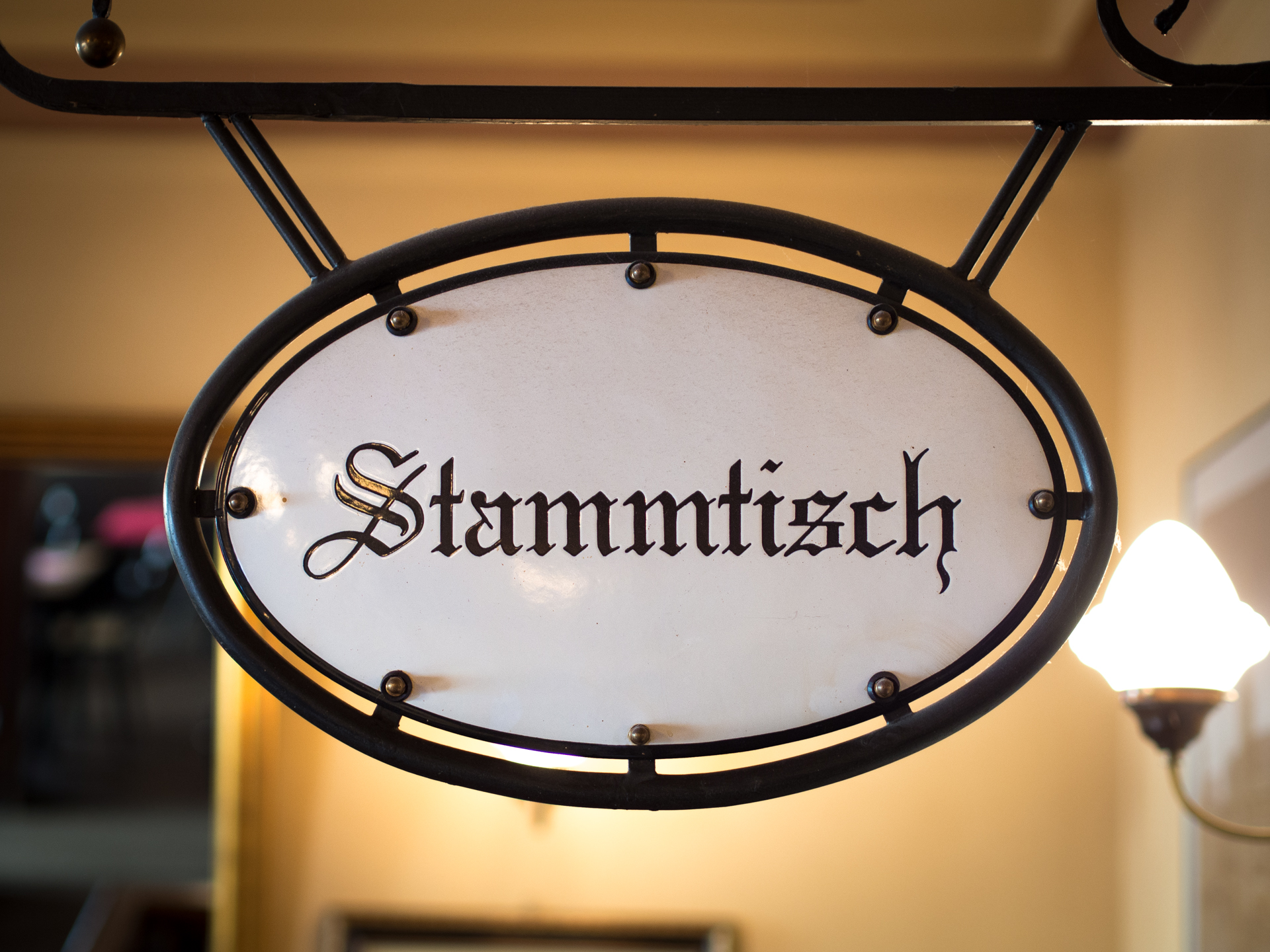
Vor dem Lesen: Ss discuss the words: Stammgast, Stammcafé, Stammtisch


During strategy:
Lesen: Ss have a copy of page 53 from "Ins Kaffeehaus" book and have read the biographical text as homework
  • Preview: read out loud biographical text about Peter Altenberg
  • View: Ss present "ich" statements that they created as homework based on the biographical text and back up with textual evidence from the original, then as a group, compose and collaborate on one common text
  • Review: as individuals, fill out a Lebenslauf form for Altenberg
After strategy: 
Nach dem Lesen: Large group discussion of Altenbergs's cemetery stone in the Wiener Zentralfriedhof "Er liebte und sah!" *Altenberg requested that this was what was put on his gravestone.*

Vocabulary/Reading activity: page 8 "Ins Kaffeehaus" book 
  • Aufgabe 2 Ss match images with verb phrases (individual)
  • Aufgabe 3 Ss describe in complete sentences what the people are doing in the images (partner work)
  • Aufgabe 4 (I would recommend this for a more advanced group)
Exit strategy: 
Ss view photo of mine from one of my visits to Café Sperl* in Vienna. Ss compete against one another to see who can make the most questions in German about the photo. Ss do not formulate answers to those questions. They just simply ask questions. 

This activity I found in a document titled "Using Visual Material in the Foreign Language Classroom" by Harry Grover Tuttle. It's listed as #5.

*Interesting factoid about Café Sperl: It was featured in the film "Before Sunrise (1995)" with Ethan Hawke. There's a quick little scene in the cafe available on YouTube that illustrates the atmosphere of a Kaffeehaus before the two main actors enter. Chuckle-worthy for sure.

Tuesday, June 21, 2016

Kaffeehaus Mittwoch: a unit for level 3

Not only am I a German teacher, I also moonlight, on occasion, as a Latin teacher. Running and planning a classical language course and a modern language course simultaneously is an extremely rewarding endeavor, because each kind of language instruction requires different pedagogical strategies. The magic happens, however, when a strategy for the instruction of one of the languages informs and inspires for the instruction of the other.

Thus was "Kaffeehaus Mittwoch" born for German, level 3.

For Latin 1, I had created "Monday Mythology."
For Latin 2, I had created "Time Machine Tuesday."
If ever I skipped one of these, my Latin students protested loudly! I imagine they appreciated the predictability and the interdisciplinary nature of these days (relevance!) along with the mental break that it offered them from the daily grind of language acquisition.

My primary source of inspiration for this curriculum is the book published by the Bundesministerium für Unterricht, Kunst und Kultur called Ins Kaffeehaus: Materialien zur Österreichischen Landeskunde für den Unterricht von Deutsch als Fremdsprache.


You can order this book here from AATG.

The book (which includes a CD for listening tasks) contains 14 chapters with many activities for all three communication modes: interpersonal, interpretive, and presentational. The book also gave me several ideas for ways in which I could search out or create my own additional activities.

Over the course of the fall semester, I was able to plan out and execute seven "Kaffeehaus" Wednesdays. I intend to develop a few more of them for next fall. The schedule ended up looking like this:

Central to all of this curriculum, was that the students themselves also created their own Stammtisch in my classroom. On these set aside days, students took turns bringing in treats to share, and I housed in the classroom a water boiler for tea and hot chocolate. We created our own Stammcafe. Observers became practitioners! This is something that we rarely are able to do on this side of the pond. All of a sudden, I'm envisioning a week's lesson in which the students reenact a Kaffeehaus scene. It would fit in perfectly following the week three lesson!

I will outline in more detail each lesson in subsequent postings. Gott sei Dank für die Sommerferien! :) Read here more about my initial first-hand experience in a Viennese Kaffeehaus.

Woche 1: Ins Kaffeehaus

Unit Essential Question
How do cultural products and practices reveal information about a culture's values or perspectives?

Daily Learning Target: I can extrapolate a cultural practice from reading a text

Alabama Course of Study Standard Addressed: Modern Language, Level III
2. Interpret culturally authentic written texts in the target language about familiar and unfamiliar topics to determine main ideas and supporting details

ACTFL Can-Do Statement: Interpretative Reading (Intermediate-High) 
I can understand the main idea and a few supporting facts about famous people.

Before strategy: 
Vor dem Lesen: Ss receive 10 previously learned vocabulary words and are instructed to illustrate simply their understanding of each word

  1. die Zeitung
  2. der Treffpunkt
  3. die Mehlspeisen
  4. die Rechnung
  5. die Tasse
  6. die Speisekarte
  7. einladen
  8. sitzen
  9. bleiben
  10. bestellen
Einstieg ins Thema: Ss are asked to answer the question "Was möchten Sie über Wiener Kaffeehauskultur lernen?" (What would you like to learn about Viennese coffeehouse culture?) The intent here is to invest the Ss personally in what we will be learning and to collect ideas for future lessons and activities for this unit. 

During strategy:
Lesen: Ss receive a copy of page 53 from "Ins Kaffeehaus" book
  • read out loud Peter Altenberg's poem "Kaffeehaus"
  • discuss the poem
  • complete Aufgabe 1, Ss write reasons in their own words why someone would visit a Kaffeehaus based on what is described in the poem (partner work, then large group share)
After strategy: 
Nach dem Lesen: Large group discussion of questions 1 and 2 on p. 53 handout

Homework: Read the short biographical text about Peter Altenberg on p. 53 handout. Based on what you read and understand, write a text in the first-person auf Deutsch, in which Peter Altenberg is introducing himself. What kinds of things does he tell us about himself? Possible topics could include, but are not limited to: education, work, family, friends, likes/dislikes, strengths, problems, etc.  

This reading comprehension strategy is a variation of the "Dramatic Monologue" activity described in the article "103 Things to Do Before/During/After Reading"

Wednesday, July 9, 2014

Cultural Comparisons and Contrasts: Utilizing Google Voice

As a teacher on a 4x4 block system, I typically have about 90 students at a time. As a teacher on a traditional 7 block system, one can have about 150 students at a time. It is a slice of my proverbial work pie that I must work to know, see, speak with, and hear all of my student every day to the best of my ability.
How I view my role as an educator, 2014
Additionally, as a modern language teacher, I need to assess my students' speaking production on a regular basis. I have experienced that with a classroom of 25-30 students, it is difficult to give up that precious learning time, so that I can hear each student speak and give feedback. 

This year, I experimented with a new tool that I believe will free up some of that time formally spent on speaking assessment. Much less often will my students sit and patiently (passively) wait for their turn at the language steering wheel. That new tool is Google Voice. 


Old teaching practice: assign students a guided conversation task to role play with a partner with a set amount of time to prepare, assess their progress by having them perform that conversation in front of the class, enter grade in gradebook

National Standards for Foreign Language Education: 
Standard 1.1: Students engage in conversations, provide and obtain information, express feelings and emotions, and exchange opinions
Alabama Course of Study Languages Other Than English: 
Modern Languages Level 1.3.: Present oral and written information in the target language using familiar vocabulary and correct structure in the present time frame.
New paradigm: assign students a guided conversation task to role play with a partner, give students an allotted amount of time and then WHEN THEY ARE READY, they submit their speaking sample IN A PRIVATE SPACE with their cellphones using Google Voice, return to the classroom to WORK ON ANOTHER TASK while other students finish, assess their speaking samples when I choose, FORWARD STELLAR SAMPLES to parents of students using Gmail with a note of encouragement (Look! Your student is speaking German! Prima!), enter grade in gradebook

Last year, I was able to do this type of activity twice with German 2 students. Both times, it went so well, that it seemed too good to be true. Only a couple of technical glitches occurred, and I just asked those pairs to resubmit their speaking samples with no penalty. No complaints, no resistance, and the students were all engaged using the target language and technology. It's truly an administrator's dream. In fact, I tweeted about my first run with Google Voice on February 5th, which was Digital Learning Day (#DLDay). My instructional partner retweeted that, which then got retweeted by the Alabama State Superintendent of Education, Tommy Bice. (Apologies for the tooting of my horn, but I thought it was nice to having world language learning recognized at the state level!)

Screenshot from my Twitter @frauboynton, 2014
I'm now considering ways in which students can use Google Voice at another level. I'd like to see them use it for culture discussion, for example. Maybe at the end of a unit of Austrian culture, like this one about the city of Salzburg, students could speak for 2-3 minutes about the similarities and differences between Salzburg and their own hometown. For novice learners, I believe that this can totally be done in English. For intermediate to advanced learners, this can be done in German. For those students at all levels, who are continuing on to Advanced Placement, this is an excellent activity to prepare and vertical team for the Spoken Presentational portion of the exam.

Google Voice also allows opportunity to do collaborative work with other subjects and classrooms. At the end of the day, building COMMUNICATION skills should be a primary objective for all educators.

CCSS.ELA-Literacy. CCRA.SL.6
Adapt speech to a variety of contexts and communicative tasks, demonstrating command of formal English when indicated or appropriate.
For a clear and concise perspective on the value of podcasting and students submitting digital work, watch this video. I believe that it applies to this arena of students using Google Voice, as well.

During the past two years, I have developed several interdisciplinary units with colleagues in my building. What if at the end of a lesson, we assessed our students' understanding of the connections between the world language and culture class and the other subject area (science, math, ELA, music, art, etc.) using Google Voice? I think that it could be even more powerful than before.

I presenting to at my school district's professional development day on this topic, so I've created a Padlet wall with the resources that I have found to be most helpful with getting ready to use Google Voice in the classroom. If you know of any others that are good, please leave a comment and share!


Thursday, June 26, 2014

Happy Anniversary to Me

First, the CLICHÉ, I did not imagine or expect that I would still be blogging about teaching the language and cultures of the German-speaking world a whole year from last June! On June 18, 2013, I posted my first blog entry. 28 entries later, I continue to write and to find inspiration regarding this discussion about how I teach, think about teaching, and reflect on teaching the language and cultures of the German-speaking world.

Second, the PLAN for year 2, now's there's a scary thought. I periodically ask myself, do I want to keep blogging? Do I have more things to share about teaching and learning? What else about my Austria experience do I want to share with my students?

Last, the HOPE that I have for myself. People often ask, "Looking back, what would you tell some younger/earlier version of yourself?" I am going to tell myself today what I want to hold as my wish for the next step in my developing, growing, evolving teacher-self...
Keep writing! 
Keep dreaming, innovating, and stretching for more! 
Keep wishing for a professional development opportunity that takes you to Switzerland!
Flammkuchen, Cafe Henrici, Zürich 2011

Lake Zürich, 2011

Farmers Market in Luzern, 2013

Thursday, June 19, 2014

No Culture Left Behind

Tag! Salve! I'm a world language teacher. I support students as they build skills to comprehend and produce a new language. I also provide them with opportunities to experience different perspectives on this thing we call life. 

Not too long ago, I listened to a woman speak about what German companies are looking for in prospective American employees. [I'm paraphrasing here.] She said, "Yeah, it's nice if Americans can speak or read or write some German, but what German employers are really looking for is an understanding of German culture, values, and perspective." 

WHAT?!?!?!?!?!?!? I've been drilling my students on verb conjugation, adjective endings, spelling rules, 16 ways to say "the", prepositions, noun cases, word order, ...... and now you're telling me that global success is more dependent on CULTURAL KNOWLEDGE & UNDERSTANDING?

"It's high time, that something changes.!" Frankfurter Flughafen, 2013
So, I began to change what I did/do. No more heroes and holidays or foods and festivals. When I create or select a LANGUAGE activity, I ask myself, "What aspect of CULTURE is present? A product, practice, perspective? If none, where or how can I add one in?" 

After doing this for a few years, I am still hitting bumps along the road. Parents of students and colleagues make complaints about culture education in the world language classroom all the time. "Too much Austria!" "All you teach is Mexico." "I can't assess culture." "I don't have time for culture." "Switzer-what?" So, I'm still searching for methods and strategies to make my teaching of culture even better.

  • How does one teach culture most effectively?
  • What are my obligations to representing the expanse of the culture relating to the German-speaking world?
  • What does a teacher of Spanish do, when there are 20+ Spanish speaking countries?
  • With Google at the steering wheel, will my students gain valuable knowledge or skills related to culture?  
  • What serves the student better: a.) a buffet-style presentation with a taste of everything along the way? b.) a three-course meal with a solid serving of a few items that the teacher/chef feels are his/her best? c.) a pile of ingredients with instructions to the students to make something? d.) something else??

Truth be told, I've NEVER had a student complain about any culture lesson. They look forward to learning about the new culture. They long to visit the places that we discuss and explore. They beg for more culture! Many of them sign up in the first place for a world language class, because of  their interest in the culture or history of the people whose language they will be learning to use. It is such a disservice to not deliver culture in a world language classroom.
Making Schultüten for German 1, 2009
A few articles about teaching culture: (ELL has been working on this for a while, WL folks!)
UNC School of Education "Teaching World Cultures" Regina Higgens
"Practical Techniques for Teaching Culture in the EFL Classroom" Cullen, 2000.

P.S.: Couldn't you just image an entire activity with the photo at the top about energy use? Reading, grammar, vocabulary, AND culture (Germany's value on global issues, German power outlets) all in one photo!


Wednesday, June 11, 2014

Austrian Art Series: Kokoschka

Schlafende Frau, Oskar Kokoschka, 1906-08
Like the girl above, many art prints are currently snoozing in my classroom closet. After two successful activities focused on paintings done by Austrian artists (Klimt's Der Tod und das Leben was the first and Kokoschka's here was the second), I am very much looking forward to using more of them during the next school year. As well, I'm so grateful for all of the resources that Fund For Teachers has afforded me, so that my students and I can experience more visual art.

Let me share with you now, how I built an activity around Oskar Kokoschka's piece "Schlafende Frau/the sleeping woman." It is actually a part of a larger series by the artist. The Museum of Modern Art in New York City has a nice write up on it. Or you can read in German at the Museum der Moderne in Salzburg about this piece.

The bold strokes and colors of this Expressionist piece completely pull me in, and I love how it gives me and my students the opportunity to discuss Expressionism, which does not get the marketing push that the Impressionists do.

The activity that I created for this artwork is for a day devoted to learning stations. Each station is given 20 minutes. The activity was completed by students in German 1. The students who came to the Austrian art station found these tasks:
  • read a biographical text about Oskar Kokoschka
Kokoschka war österreichischer Maler und Dramatiker.
Er wurde 1886 in einem Dorf namens Pöchlarn in Österreich geboren. 
Er wohnte und studierte in Wien, als er jung war. 
Er ist bekannt als Maler des Expressionismus, wie Vincent Van Gogh und Edvard Munch 
Er kämpfte in dem ersten Weltkrieg. 
Er reiste gern und wohnte in vielen anderen Orten, wie zum Beispiel, England, Nordafrika, und Deutschland. 
Er starb am 22. Feb 1980 in der Schweiz.

  • view the painting
  • discuss with your group the painting using the prompts provided and record your responses.
  1. Was siehst du im Bild?
  2. Welche Farben hat Kokoschka benutzt?
  3. Was passiert im Bild?
  4. Wo ist das Mädchen?
  5. Wie findest du Kokoschkas Gemälde?
  6. Was für Gefühle drückt sich das Gemälde aus? Freude? Angst? Traurigkeit? Mut? Wut? Etwas anders?
  7. Geben Sie dem Gemälde einen Titel.
In retrospect, I need to develop an activity to accompany the biography reading. Not sure what to do with that yet. I don't want it to be too complicated, but it needs something that motivates the students to actually read the text. Maybe a targeted word list for the students to sketch?

I'm glad that I'm pushing my personal envelope and utilizing art in the classroom. I'm dreaming of a summer workshop in Switzerland that is all about art history in the German-speaking world. Can someone get on developing that for me?

If you are interested in a copy of the handout that I made for this activity, please feel free to leave a comment and let me know.

Hooray to me for completing a blog entry about an activity that was completed in November! :)


Friday, June 6, 2014

Salzburg For The Win!

Since living and working in Alabama, I have been taking groups of students to the University of Alabama German Day, which is our day of competition and exhibition for all students who study German in Alabama. Events are divided into three main categories: speaking performance, academic challenge (writing, reading, listening), and visual/artistic. Underneath the umbrella of academic challenge is a contest known as Geography. Each level of German is assigned a city or region to prepare for a pencil-and-paper quiz. This year, my German 2's received Salzburg as their assignment, so I seized this opportunity to integrate some more Austrian cultural perspective into the classroom.

My teaching strategy for this topic was structured so that almost everyday over the course of approximately three weeks (beginning in mid-February and lasting up until German Day itself, March 7th), my students would work with a bit of Salzburg culture and/or geography.

I've never been a fan of memorizing dates, facts, and figures, so I had this challenge of how to make this information RELEVANT and AUTHENTIC and INTERESTING for all involved. To accomplish this goal, I chose to keep it very visual, personal (whenever possible) and language-based as possible.

Here is the schedule of topics and activities that I ended up using:

  • Introduce Salzburg as a UNESCO World Heritage Site because of its Historisches Stadtzentrum, show a photo of the Getreidegasse and the Markt with the Salzburger Brezen stand

Salzburg, 2011
  • Wolfgang Amadeus Mozart, Mozart's Geburtshaus (read the sign hanging outside it), Notice the use of "Jänner," and read a short bio written by me about Mozart

File:Mozarts Geburtshaus.JPG
commons.wikimedia.org
  • Physical geography of Salzburg, used text from wikipedia.de (it was one of the recommended resources to read from the University of Alabama) and an outline map of Austria for labeling, students also had to create three reading comprehension questions of their own of any type in German after reading the text.

—  Die Stadt Salzburg liegt an der Salzach (der Name eines Flusses) und am Nordrand der Alpen. Salzburg ist ungefähr 150 km südöstlich von München (BRD).— —Sie ist die Landeshauptstadt des gleichnamigen Bundeslandes und mit 145.871 Einwohnern (Stand 1. Januar 2013) nach Wien, Graz und Linz die viertgrößte Stadt Österreichs.— —Der Name “Salzburg” kommt aus der lateinischen Sprache “Salis Burgium”. Die Römer wohnten dort von dem 1. Jahrhundert vor Christus bis 5. Jahrhundert vor Chr. Salzburg trägt auch den Beinamen “Mozartstadt,” denn in 1756 wurde Wolfgang Amadeus Mozart, weltbekannter Komponist, dort geboren.


  • Salzburg and what it experienced during World War II beginning with the Anschluss 1938 through the American bombings 1944-45 and how it changed the city
  • The Mirabellgarten, Zwergelgarten, and the filming of The Sound of Music (lots of photos for this one plus a video clip of course from the movie)
  • Famous Salzburger: "Wolferl", Johann Michael Haydn, C. Doppler, Joseph Mohr, Georg Trakl, Felix Baumgartner, Maria von Trapp. I gave the students a slide with clip-art and images on it representing each person and asked them to guess who belonged to each image. 
  • Stiftskeller St. Peter (oldest restaurant in Europe!) and Salzburger Nockerl I just realized I should have had them read the recipe for this!
Salzburg, 2013
  • Salzburger Dom, the Kollegienkirche, religion and the story of St. Rupert who revived the town with the salt mines 
At the very end of it all, we played a Survivor-style game called "Mensch, Ort, oder Sache." Since the geography quiz at German Day would be trivia-based, I wanted our final formative assessment to model that. It was fun. On the day of the quiz, we didn't have any winners, but that's okay because the experience of focusing on Salzburg was very rewarding and enriching. 

Personally, I learned about the Zwergelgarten while preparing for these discussions, which I had missed both times I was in Salzburg, so now I have something to seek out the next time that I am there!

If you have any other ideas of topics regarding Salzburg that I could include for my next go-around with this unit, please share! Continue to teach culture. It's vital to language learning.


Sunday, January 26, 2014

Kulinarisches

Marillen aka Aprikosen fresh from the fruit trees in Graz, 2013

It's a fortuitous thing that my German 2 class is scheduled during third block, which wraps itself neatly around our lunch block. A January 2014 article on National Public Radio on how language affects our view of the world mentions recent research that "...that if you're hungry, you'll pay more attention to food-related stimuli." Fingers crossed and thumbs pressed that Kapitel 8 will be a slam-dunk for this class!

Part of the theme for chapter 8 is groceries. I used this opportunity to integrate p. 10 from my Österreich-Quiz book that I've mentioned using before. My strategy for this lesson was to allow the students the chance to explore "the puzzle of Austria from a culinary point-of-view." I imagine that of all the potential situations that my students could be placed in inside of the German-speaking world someday, interpreting and ordering of off a menu is the most likely to happen.

I think that this exploration activity lends itself well to device use as well. With a tablet, smartphone, or other web-connected device, food items are very easily found and understood by using Google Images or the Culturally Authentic Pictorial Lexicon. As I was prepping for the activity myself, I searched for "Striezel", because I didn't know what it was. With a snap of my fingers...

...asked and answered: a braided Challah-type sweet bread. This activity models for the students how to work within the context of culture and language that we are learning, while simultaneously stretching and reaching out for more.

My questions for the students were focused on cultural practices, perspectives, and products while communicating in the German language. I find this activity to be more deeply connected to why the students learn German in the first place. Here is what some of the questions sound like:

  • Not "What do you eat for breakfast?" but "What does a breakfast in Vienna look like?"
  • Not "What do you eat for dinner?" but "What are specialties of Austrian cuisine?"
  • Not "Do you like to drink this?" but "What would you order in an Austrian Kaffeehaus?"
  • Not "What is the German word for potato?" but "What variants exist in the German-speaking world regarding food?"
Don't get me wrong. I use those first set of questions all the time in the world language classroom. I'm challenging myself to take it to the next level, especially when it comes to the integration of culture into the lesson. 

Thursday, November 7, 2013

Austrian Art Series: Klimt

One of my goals for this year is to incorporate more art exploration and discussion into my lessons. After having spent a week in Vienna this summer, I am more motivated and slightly more knowledgeable than ever before, so it's time to take the plunge.

Halloween winked then waved at me and became my starting line. Ready, set, ...Klimt! Gustav Klimt for Halloween! I still remember that first afternoon in Vienna this summer. Exhausted from almost 24 hours of travel, I was determined to go out into the city and do something, anything. Since my hotel wasn't too far from the Museumsquartier, I eventually landed at the Leopold Museum, which I basically knew nothing about. Truly, I think it's better to travel with out too much knowledge or expectations for your destination, otherwise it just leads to general disappointment. (Exhibit A: the Mona Lisa.)

The Leopold, it turns out, was originally a private collection and currently houses around 5,000 pieces of Austrian art. It was a perfect viewing experience for me, since focusing on Austrian culture and history was the point of my trip anyway. None of those dusty Dutch masters or fuzzy French Impressionists getting in my way at the Leopold!

And then I saw it. I didn't know at the time how I would use it, but use it I would. And, I did. On Halloween. Gustav Klimt's Tod und Leben (Death and Life).
Vienna, 2013
Here's my lesson for German 1 on a 96 minute block:
  1. Hook: Johann Sebastian Bach Tocatto and Fugue in D Minor as students enter classroom
  2. Reading activity: sentences from SlowGerman.com podcast on Halloween that introduce the topic and the idea that Halloween is not a German holiday in any way
  3. Speaking activity: Möchtest du Bonbons?
  4. Vocabulary/listening activity: Halloween-y words matching and then bingo. Students draw the pictures and then listen for the German words
  5. Writing activity: write three sentences of your own using Halloween words
  6. Culture activity: Halloween-themed art piece
  • I introduced the artist in simple German sentences.
  • We viewed the art piece and I used new vocabulary in conjunction with the piece (Gemälde, Kunstmuseum, Maler, Sensenmann, Tod, Leben)
  • Then we simply just discussed in English their impressions of the piece and compared it to Klimt's Der Kuss
I was surprised by how well the lesson went. Having not really used art to teach before, I was surprised to see how little the students know about art. I'm not an art teacher, nor an artist, so I don't have any ground to stand on at all, but is art history/appreciation left aside in fine arts curriculum? I don't know the answer to that question, but I do know that as I continue to have lessons about Austrian art throughout the year, I'm going to have to build a framework for my students for understanding a bit about art movements and styles.

If you can recommend any supportive level-appropriate sources for art history, please let me know. If you have any experience teaching art in your non-art class, please share! I would like to know what works and what doesn't.

In allowing culture to drive more of my lessons, I am discovering that the language instruction is much more of a joy. I hope that the students feel it, too.

Saturday, October 19, 2013

The sky's the limit

Austrian sky, 2013
"I teach science to 6th graders. Our project took us to Costa Rica to study its eco-systems. I walked through a rainforest that before I had only read about in books. I climbed a volcano, stood on its edge peering down into its crater, and wept. This experience had expanded my knowledge as a teacher and a learner and provides an intense amount of joy to my students."
"The people in the country I visited were so open, friendly, and generous to me. I was amazed how they lived their lives so deeply with seemingly so little to my American eyes. It has truly caused me to reevaluate my priorities." 
"I should have dreamed bigger with this grant! There is so much out there in the world to learn about and experience that I can bring back to my classroom."
"I teach a class that contains students from the highest of the high ability and the lowest of the low. And yet inexplicably when I relate to them stories from my experiences this summer and show them photos or books that I personally collected during this experience, it draws them together. It levels the playing field in a way that I can't explain. It makes the learning real for them."
"We left for our conference as a team. We came back a family. Our team now collaborates together consistently and intentionally."
All of these statements* I heard today at my post-fellowship meeting for the Fund for Teachers grant that made this whole blog and my summer experience possible. I was so inspired by each of the stories and reflections both personal and professional from each of the educators present at the meeting. My wish is for every teacher at my school to have an opportunity like I had: to imagine a journey and then to be given the resources and support to go on that adventure.

The Fund for Teachers grant was finally a professional development experience that had and continues to have a DEEP impact on my work every single day. I encourage every single K-12 educator out there, who picks up pencils off the hallway floor to save for later, has a scrap paper box for all sheets of paper that have a portion or corner that can possibly be reused, and sees all free sandwiches as good sandwiches, to embrace the gift that is a Fund for Teachers grant.

Conjure up your dream professional development proposal! How about a Latin language immersion experience by the sea? Or would you rather a Science by the Sea cruise? Is there a summer conference you've always wanted to attend? Most likely, you will create a project proposal that will give you growth opportunities that you hadn't even imagined would happen. I could go on and on listing possibilities. The 531 Fund for Teachers fellows from 2013 have 531 great ideas, if you would like to see some.

Begin the application process now. January 30, 2014 is the deadline. Close your eyes. Imagine your learning bliss. The sky's the limit.

Feel free to contact me here through my blog if you have questions. Good luck!


*I paraphrased and recalled these sentiments as best as I could.

Sunday, October 13, 2013

Learning through poetry

Sometimes you simply cannot predict the impact or reaction that your students will have to a lesson. Sometimes lessons fizzle and flop over dead. Sometimes they soar, lifting everyone up creating a memory that sticks. This tiny lesson about numbers and Austrian poetry did just that.

The poem is called "12! ein Zahlengedicht" by Gerhard Rühm. Rühm is an Austrian-born poet of the late 20th century. I experienced his poetry during a seminar session about music and lyrics while in Innsbruck, Austria. Rühm's poem was buried in a huge list of musical selections and lyrical works that we heard and read as a group. "12!" jumped off the page as something exactly perfect for use in beginner level German class.

So, a few weeks ago after we worked through learning the numbers up through 100, I introduced Herr Rühm to my students with three simple sentences in German. Then, we listened to Rühm himself reading his poem. The students were totally sucked in. It was so unexpected for them. We had an awesome discussion about the poem after. The students still bring it up.

You're just going to have to read and/or listen to the poem yourself to know what I am talking about. Enjoy!

Photos courtesy of Dr. Michael Shaughnessy, Collage created by author, 2013

Thursday, September 26, 2013

Franz Schubert was from Austria and more

After completing my Fund for Teachers grant experience this summer, my brain felt stuffed with experiences and knowledge, but then once the dust settled and all of the chocolate was gone, I began to feel like that old saying, "The more you learn, the more you realize there is that you don't know." The more that I look back on all that I learned this summer about Austrian culture and history, the more I feel like I have so much more to discover.

And then, to top it all off, it seems like things about Austria just keep falling into my lap like ripe, perfect apples off of a tree. Here's the story of the most recent one.

A couple of weeks ago, a former Latin student of mine was visiting me and mentioned that she was learning how to sing a song in German in her choir class. I asked her how it was going, and she said that the choir and the choir teacher were feeling frustrated, because no one in the group knew how to pronounce any of the German words.

OPPORTUNITY!
Collaboration between disciplines!
       Exposure to German culture and German class to students not already enrolled in German!
             Grow the program!
                  Chance for my students to work at the top level of Bloom's Taxonomy by teaching what they were currently learning!

So, I contacted the choir teacher, who was thrilled to hear that we wanted to help out, and two days later my German 1 class in their 4th week of German was teaching the choir students how to pronounce the German words in Franz Schubert's Sanctus from the German Mass in G.


To prepare for this collaboration, I also did a little reading myself on Franz Schubert. Biography.com has a pretty good write-up on him. Turns out that ol' Franzie was Austrian by birth and lived most of his life there. He's buried at the Zentralfriedhof in Vienna. (I'm slapping myself for not visiting the Zentralfriedhof while I was in Vienna this summer. I guess you can't do it all.) I also learned that Schubert died at the age of 32. Wow! So young and so accomplished and full of genius!

I presented this to the students as part of the introduction to the collaborative lesson. Also, interesting to read were all of things that Schubert did not succeed at. I am pondering the idea that when we present famous figures in class, we do tend to gloss them up a bit. Maybe the students need to see the successes and the failures of the historical figures that we read and discuss. I'm definitely going to work on that.

Music was a significant piece to my experience with Austrian culture this summer. While in Innsbruck, I was able to attend a free outdoor concert, and it was extremely inspiring. I won't forget relaxing back into the recognizable classics and then being catapulted forward into new, innovative pieces that challenged my perceptions about orchestral music. (see: Melodies floating the summer air)

As an added bonus, the choir teacher is going to look into doing a holiday lesson with my German 1 using some German songs like: O Tannenbaum, Stille Nacht, etc. If you have any suggestions for music/songs that we could easily use, please let me know!

So, thanks to my student who came to her teacher for help, which challenged me to turn my students into teachers for the day, while at the same time, I became a student again learning more about one of Austria's most famous composers.
Mozart garden in Vienna, 2013

Tuesday, September 17, 2013

Implementation round 3: Cordoba!


F.U.S.S.B.A.L.L. = soccer
1978. Defending World Cup champions, the West Germans, faced up against the Austrian National soccer team.  At home, the German team had shelves creaking and bending under the weight of so many trophies: 1st place in 1954, 4th place in 1958, 2nd place in 1966, and 3rd place in 1970. The Austrian team, on the other hand, had 1 third place win in 1954, and that's pretty much it. The odds were not in their favor to be sure.
But in spite all of that, deep in the heart of Argentina in a city called Cordoba, Austria toppled the West German soccer powerhouse 3 to 2.

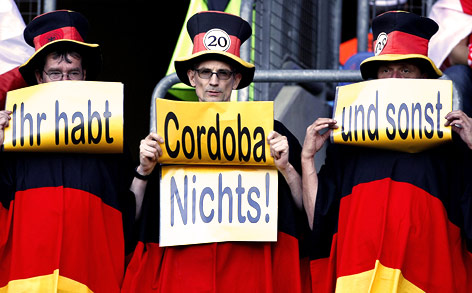
Drei Deutschlandfans halten vier Zetteln mit den Aufschriften "Ihr habt", "Cordoba", "und sonst" und "nichts"Apparently, the Germans and the Austrians are STILL talking about it. Given the history of the 20th century, my students are often intrigued by the idea of rivalry, competition, or contention between the D-A-CH countries. It wasn't until I sat in on the lecture during my summer seminar given to us about immigration in Austria, that I gained any insight into this cultural perspective. It all comes down to one thing: sports.

 
Since I was finishing up a chapter about hobbies and sports, I thought that I could work in a small bit about this rivalry between Austria and Germany. I shared the story with the students about the 1978 game. We looked at vocabulary like das Wunder von Cordoba, die Schande von Cordoba, immer, schlagen, and Mannschaft. And to ensure that I was presenting a balanced view on the story, I showed this image of current t-shirt, so that we could include Switzerland in the discussion.

Interestingly, t-shirts provide excellent authentic text for beginning to intermediate language learners. They are short, sweet, often funny, and intensely contextualized.

A few days following this lesson, a student came up to me after class and shared that while playing on a German server for an online game the previous night, he got into a discussion with a German with whom he was playing, who was a fervent soccer fan. My student ribbed him with his knowledge of the loss at Cordoba. The German guy was less than thrilled and threatened to kick him out of the game that night! I'm sure he was joking, but my German 1 student had this proud sparkle in his eye that he had that little piece of cultural knowledge tucked up his sleeve. I couldn't help but smile from ear to ear as he shared his encounter. This is proof positive to me that teaching culture matters, and I'm not going to put it on the sidelines any longer.

Friday, September 13, 2013

Kaffee 2

Based on the outstanding popularity of the previous post's topic, I decided to write a follow-up. First, let me show my gratitude to all who shared ideas for creating a lesson about Viennese Kaffeehäuser. Second, let me pass those suggestions on to you.

From R. in Illinois: a video in German from the Deutsche Welle series "Euromaxx" available through YouTube. The language is at a more advanced level, but I think that since it is only 4 minutes long and very contextualized with imagery, you could use it for beginners with the right kind of comprehension questions or simply as authentic material for interest.


From K. in Minnesota: an article from the magazine Spiegel Online called "Die Bohne der Erkenntnis." It is pretty long to use in toto, but I think that sections of it would work in my classroom. I especially liked the introduction section, which, in my opinion, gives a very GERMAN perspective on the coffee experience, which I think I could use to contrast with the Austrian point-of-view of coffee consumption. I also really liked the historical bits and current statistics, which I think you could easily use with students at all levels. Wait, I think I'm envisioning a math/German lesson...

From G. in Iowa: a promotional video in English from Viking Cruises about Café Demel. It's a little shiny and makes my wallet cringe, but at the same time it shows the luxurious angle of the Kaffeehaus, especially all those cakes and sweets, which take my breath away.


From my own Internet trolling: some quotes from German-speakers about coffee. I love words and quips and poems (and apparently the word "and") in the classroom, because they provide authentic language at an accessible amount for beginning language learners.

„Kaffee dehydriert den Körper nicht. Ich wäre sonst schon Staub.“ - Franz Kafka
(Coffee does not dehydrate the body. I would already be dust.)

„Für mich ist es am schönsten im Kaffeehaus. Man ist nicht zu Haus und doch nicht an der frischen Luft.“ - Peter Altenberg
(For me, it is nicest in a coffeehouse. You're not at home, nor out in the fresh air.)

I have to say I disagree with Herr Altenberg. When I visited the Café Sperl on several occasions while in Vienna, I enjoyed sitting outside the café the most. Granted, it was July.

I'm still looking for Kaffeehaus ideas. Keep sending them my way!
My POV, Vienna 2013